It occurred to me recently that I no longer use bookmarks. I used to and very useful they were too. Nowadays I just don't bother with bookmarks. Why? What is forcing bookmarks out?
Tabbed browsing
If I really need to remember a site, it's because it's an 'internal' system (intranet) for example and I'm just too lazy to remember the URL. Solution? I set my homepage tabs to open on startup effectively replacing the need for bookmarks in that instance.
Browser history
If I think I can sorta remember the start of the URL, I'll chuck a few attempts in the browser address bar and see what suggestions pop up. Easy, quick and convenient. Certainly quicker than a nested menu of bookmarks.
Multiple machines and browsers
Counting up very quickly I reckon I could use up to 3 different machines on a daily basis - sometimes more if I am lending a hand or sharing work with someone else. These machines are likely to have Chrome, Firefox, Safari and....ahem..IE (Eeew - I feel dirty just saying it) - no point in using bookmarks in this instance...Yeah, I could use Google bookmarks but I don't want to put my Google account credentials into just any old machine or have to log anyone else's Google account out.
Google
So, my home tabs don't contain a certain site and I can't find it in my history and I can't guess the URL from my sketchy memory....Hmmm. What now? GIMP duh! Google Is My Pal. For heavens sake, obviously the biggest and bestest search engine on the planet is making it soooo easy to find a site that bookmarking a site or page is less than worthwhile.
If I made a bookmark in the past, it was quite possible that the page URL might change or the page could go away etc etc. So I had to maintain my own bookmarks. Meh, I think I'll just let the big G maintain it's own index and I'll search like usual if that's okay?
So, bookmarks anymore? I wouldn't be surprised if a total newbie to the web doesn't 'get' the concept or see the need for bookmarks. Similarly I wouldn't be surprised to see bookmark functionality disappear from browsers in the future too.
Funny how culture changes huh?
Saturday, 10 July 2010

Thursday, 10 June 2010
Engineers are from Mars, Marketers are from Venus, Designers are from Jupiter.
Why traditional, isolationist approaches to marketing, engineering and design are not effective approaches to growing online businesses.
Engineers consider design to be ‘packaging’ and marketing to be ‘headaches with pictures’ (I know this as I was/am an engineer!).
Designers consider design to be the process where the product of engineering is made less ugly.
Marketers consider design and engineering to be servants to capitalism - of their making.
These essential groups of business functions seem destined to be at odds. Historically the functions of engineering, design and marketing are discretely serialised and compartmentalised. As will be demonstrated, there are clear historical precedents that should be heeded lest we all make the same mistakes again and not realise that the best engineering/marketing/designing is a accomplished through a single cohesive entity.
To sell all you can make or to make all you can sell?
Product design, engineering and marketing are all influenced by economics, politics, consumerism and social upheaval. We can see now the degree of influence and significance of change the industrial revolution had on the process and science of design and engineering in the 18th and 19th centuries. So, consider the innovation and disruption being caused right now by a contemporary revolution sparked by the iPad -1 million units sold in 28 days after launch and analysts predicting double digit millions to be sold by year end.
Consumerism can be defined as the buying, selling and recycling of products: a major catalyst for change. We should take note of change like this. We ignore the powerful effects of consumerism during ‘iPad style’ social upheaval at our peril...Henry Ford learnt the hard way:
Fighting to reduce unit costs through maximising volume, the model T production line reduced the time and therefore price to build a product from 12 hours down to 93 minutes. An incredible accomplishment but this economic scalability came at the price of aesthetic appeal notable by his most famous quote - ‘Any customer can have a car painted any colour that he wants so long as it is black’. Ford’s achievements and failings don’t necessarily reflect his original and noteworthy intentions:
"I will build a car for the great multitude. It will be large enough for the family, but small enough for the individual to run and care for. It will be constructed of the best materials, by the best men to be hired, after the simplest designs that modern engineering can devise. But it will be so low in price that no man making a good salary will be unable to own one—and enjoy with his family the blessing of hours of pleasure in God's great open spaces."
Had Ford met his goals as stated, this would have been a sustainable commercial success for much longer but the execution of the strategy had shortcomings. Where mass production gave economic scalability, the over-specialisation and in-built lack of business agility rendered the Ford production machine unable to respond quickly or accurately enough to the consumer’s new-found fickleness. Where standardised parts and specialised tools can be combined with relatively little skill to achieve mass production, the over-reduction of the skill element and the over-specialisation of tools are symptomatic of engineers ignoring the design and marketing aspects of building businesses. Ford confessed that the design of the model T was secondary to the engineering brilliance that enabled mass-production.
Are you a Roundhead or a Cavalier?
It has been suggested that two schools of design can be considered:
Roundhead - focussed on function
Cavalier - focussed on form and aesthetics
Some aspects of each school will be appealing to engineers, some to marketers where one might suggest that traditional design is cemented in the Cavalier camp.
Japanese design considers simplicity (both aesthetic and functional) to be a virtue in terms of economics and design. One might suggest this also applies to business solutions.
There are myriad advantages to such a philosophy. Aspiring to fewer moving parts reduces complexity and eases comprehension. Simple and elegant solutions generally pose fewer risks and present a smaller cost. The simple solution is inherently flexible and agile. Let us avoid the confusion between over-complex and sophistication. One can achieve sophistication whilst retaining the qualities of simplicity and elegance.
Now, Ford was a hard-core roundhead, de-skilling is labour force and specialising his tool set for mass production and aligning his output for mass use rather than mass appeal. Barely an after-thought nod to the neglected Cavaliers.
Putting this history lesson into context, let’s think about online businesses...Clearly, we can see merit in functional (Roundhead) and aesthetic (Cavalier) philosophies. Can we honour both approaches and in essence harmonise the functions of design, marketing and engineering to capitalise and the respective strengths without rendering our solution overly complex and unwieldy?
The question is how do we effectively re-skill resources and be agile enough in our respective disciplines in order to deliver an online business that has both mass appeal (Cavalier) and mass use (Roundhead)?
Catering for the market of one
First of all we need to be aware of the combination of relevant skills that are to be employed. I’ll pick a few out of a hat...
In isolation these are all really strong, marketable skills. They are all relevant and are used to deliver solid, sustainable growth to online businesses.
I recently migrated from a hands on technical leadership role that combined a number of the ‘roundhead’ skills and qualities above to an online marketing leadership role that would have been thought of as a ‘Cavalier’ mindset by my previous peer group. I am met by some perplexed enquiries as to what drove me to be a turn-coat:
‘CTO to Head of Marketing? Chalk and cheese surely?‘
No - I’m not a turn-coat and there isn’t a huge difference in terms of the skill sets that need application. The big change is in terms of mindset regarding how to apply the skills and why.
Recognising that the skills are present (throughout the team) and that they need simple, cohesive application to extract maximum value (for the clients) was somewhat of a House/CSI style epiphany. It’s really obvious but a formulaic approach of broadening and strengthening the skills of existing assets enables the roles of design, engineering and marketing to be combined into fewer resources (ideally one individual).
Engineers consider design to be ‘packaging’ and marketing to be ‘headaches with pictures’ (I know this as I was/am an engineer!).
Designers consider design to be the process where the product of engineering is made less ugly.
Marketers consider design and engineering to be servants to capitalism - of their making.
These essential groups of business functions seem destined to be at odds. Historically the functions of engineering, design and marketing are discretely serialised and compartmentalised. As will be demonstrated, there are clear historical precedents that should be heeded lest we all make the same mistakes again and not realise that the best engineering/marketing/designing is a accomplished through a single cohesive entity.
To sell all you can make or to make all you can sell?
Product design, engineering and marketing are all influenced by economics, politics, consumerism and social upheaval. We can see now the degree of influence and significance of change the industrial revolution had on the process and science of design and engineering in the 18th and 19th centuries. So, consider the innovation and disruption being caused right now by a contemporary revolution sparked by the iPad -1 million units sold in 28 days after launch and analysts predicting double digit millions to be sold by year end.
Consumerism can be defined as the buying, selling and recycling of products: a major catalyst for change. We should take note of change like this. We ignore the powerful effects of consumerism during ‘iPad style’ social upheaval at our peril...Henry Ford learnt the hard way:
Fighting to reduce unit costs through maximising volume, the model T production line reduced the time and therefore price to build a product from 12 hours down to 93 minutes. An incredible accomplishment but this economic scalability came at the price of aesthetic appeal notable by his most famous quote - ‘Any customer can have a car painted any colour that he wants so long as it is black’. Ford’s achievements and failings don’t necessarily reflect his original and noteworthy intentions:
"I will build a car for the great multitude. It will be large enough for the family, but small enough for the individual to run and care for. It will be constructed of the best materials, by the best men to be hired, after the simplest designs that modern engineering can devise. But it will be so low in price that no man making a good salary will be unable to own one—and enjoy with his family the blessing of hours of pleasure in God's great open spaces."
Had Ford met his goals as stated, this would have been a sustainable commercial success for much longer but the execution of the strategy had shortcomings. Where mass production gave economic scalability, the over-specialisation and in-built lack of business agility rendered the Ford production machine unable to respond quickly or accurately enough to the consumer’s new-found fickleness. Where standardised parts and specialised tools can be combined with relatively little skill to achieve mass production, the over-reduction of the skill element and the over-specialisation of tools are symptomatic of engineers ignoring the design and marketing aspects of building businesses. Ford confessed that the design of the model T was secondary to the engineering brilliance that enabled mass-production.
Are you a Roundhead or a Cavalier?
It has been suggested that two schools of design can be considered:
Roundhead - focussed on function
Cavalier - focussed on form and aesthetics
Some aspects of each school will be appealing to engineers, some to marketers where one might suggest that traditional design is cemented in the Cavalier camp.
Japanese design considers simplicity (both aesthetic and functional) to be a virtue in terms of economics and design. One might suggest this also applies to business solutions.
There are myriad advantages to such a philosophy. Aspiring to fewer moving parts reduces complexity and eases comprehension. Simple and elegant solutions generally pose fewer risks and present a smaller cost. The simple solution is inherently flexible and agile. Let us avoid the confusion between over-complex and sophistication. One can achieve sophistication whilst retaining the qualities of simplicity and elegance.
Now, Ford was a hard-core roundhead, de-skilling is labour force and specialising his tool set for mass production and aligning his output for mass use rather than mass appeal. Barely an after-thought nod to the neglected Cavaliers.
Putting this history lesson into context, let’s think about online businesses...Clearly, we can see merit in functional (Roundhead) and aesthetic (Cavalier) philosophies. Can we honour both approaches and in essence harmonise the functions of design, marketing and engineering to capitalise and the respective strengths without rendering our solution overly complex and unwieldy?
The question is how do we effectively re-skill resources and be agile enough in our respective disciplines in order to deliver an online business that has both mass appeal (Cavalier) and mass use (Roundhead)?
Catering for the market of one
First of all we need to be aware of the combination of relevant skills that are to be employed. I’ll pick a few out of a hat...
- Commerciality
- Engineering/Technical
- Statistical modeling
- Qualitative, quantitative and competitive intelligence analysis
- Communication
- Design
- Strategic leadership
- Rigour
- Discipline
In isolation these are all really strong, marketable skills. They are all relevant and are used to deliver solid, sustainable growth to online businesses.
I recently migrated from a hands on technical leadership role that combined a number of the ‘roundhead’ skills and qualities above to an online marketing leadership role that would have been thought of as a ‘Cavalier’ mindset by my previous peer group. I am met by some perplexed enquiries as to what drove me to be a turn-coat:
‘CTO to Head of Marketing? Chalk and cheese surely?‘
No - I’m not a turn-coat and there isn’t a huge difference in terms of the skill sets that need application. The big change is in terms of mindset regarding how to apply the skills and why.
Recognising that the skills are present (throughout the team) and that they need simple, cohesive application to extract maximum value (for the clients) was somewhat of a House/CSI style epiphany. It’s really obvious but a formulaic approach of broadening and strengthening the skills of existing assets enables the roles of design, engineering and marketing to be combined into fewer resources (ideally one individual).
Saturday, 5 June 2010
Simples! It ain't as simples as it seems...
Simples! Isn't it?
I always look forward to a new Avinash blog post. The title of Avinash's blog is Occam's razor - the simplest explanation is usually the best one (entia non sunt multiplicanda praeter necessitatem as I always say!...)
Unfortunately the simplest and best solution, it seems, is seldom chosen. Why is this? What problems does this cause and why did I choose to waffle about this today?
Why so serious?
So why choose to over complicate? What is the motivation to choose complexity where simple answers with fewer moving parts, lower risk and lower cost are available and more appropriate? Brand fixation? Misplaced loyalty? Vendor favouritism? Ignorance? Cognitive miserness - too stingy to think beyond...oh, whatever! Perhaps it's too hard to choose? Perhaps...just perhaps it's the case that a chosen solution is perceived to be better due to the presentation of the solution? Appearing to be simpler or better or requiring less effort (at least in the short term - cognitive miserliness?) is a strong decision making trigger.
Why is this common occurrence a matter for discussion and exploration? As with ANYTHING in life - if the barrier to entry [for a solution] is too high then the level of average quality [of the solution] will be low(er). Take the state of the economy in the UK as an example. Pubic spending has been 'out of control' for years...well, it's been massively wasteful and inefficient due to massive complexity - this much is clear. Is the new government seeking to simplify and add efficiency to resolve the situation? I bloody hope so but this is not a political blather...I want to contextualise on tech..soon.
So, you see what happens when over complex or JPW (Just Plain Wrong) solutions happen? Badness - simple. The fix? Adjust the perception of the actual simple solution compared to that of the complex solution in order to trigger the right choice.
If the simple solution becomes the mean choice this will, in general, lower the bar to entry and the inverse (dis)proportional relationship with quality will yield many more smiles per gallon. Simples, right?
Appear effortless
Well, not quite...The oxymoronic art of presenting a simpler yet better solution still requires a whole bucket of clever!
My TV set has one button - On/Off. Modern aircraft are designed to be simpler to fly through fewer levers and buttons in the cockpit. Automatic gear boxes in cars simplify the job of driving. Heck, I can even use a washing machine (and do!!). These real life examples of 'simpler is better' still contain some mega-clever action under the hood. We don't see (or care) about it though. We see the simple and subconsciously blank out the clever. Our perception of these solutions for life problems is that they are simple. They are presented in a way such that the 'simple' is IN-YOUR-FACE. You can't miss the simple. The solution appears effortless whilst in actuality they are 110% smart. Tricky but so worth the effort.
Get to the point already
Yes - where is this going? So - the crux...I can't tell you the full details yet. The solution will be an Open Source product for the measurement and control of website performance. It is clear that the majority of Web Analytics solutions whilst appearing smart and good are actually harming rather than helping. There is a better way and it will be delivered democratically, for free and doable with apparent effortlessness. Think 'one liner' solution that does all the things you need with little or no thought.
Interested?
Here is a promise - simples will be better and unavoidable.
Sunday, 4 April 2010
Understanding the Mclaren F1 rear wing 'stall' device
The 2010 Mclaren F1 car has a clever device to make the car go faster on the straights be reducing drag from the rear wing. Martin Brundle (and many other journalists) has, I think described the so called 'Rear Wing Stall Device' poorly.
Here is an explanation using basic aerodynamic theory that shows that the wing does not actually 'stall' but appears to 'get smaller'.
Here is a normal aeroplane wing:

Air flows over the curved top surface of the wing as it moves forwards through the air. Because the air is being made to change direction the air molecules bash into each other as they bend around the curved wing. All this bashing around makes the molecules move further apart - they need more space to bash and move and bend. Moving further apart reduces the pressure of the air on the top of the wing. This reduction in pressure on top actually sucks the wing up.
The stall.
For this suction effect to work properly, the air needs to move around the wing surfaces and stay nice and close to the surface. If the direction of the airflow changes so that the flow is perpendicular rather than head on then obviously the wing will not work. It presents it's bottom surface and behaves like a fence panel being blown by the wind in a storm. Lots of force in the wrong direction = drag! This is a stall. A stall does reduce the downforce of a wing but it will INCREASE a wing's drag - NOT REDUCE it!
Here is a normal formula one wing:

See how the wing is angled to optimise the downforce but not cause a stall as described above? Notice also that it appears to be upside down? A formula one wing wants to push/suck down where an aircraft wing wants to push/suck up.
So, if the Mclaren rear wing device is not stalling the wing what is it doing? A non-stalled wing will create a force in the correct direction (down for F1) but in doing so it will also cause another force to act one the wing - drag. The wing creates this force as described earlier by creating a pressure differential - the high or ambient pressure on the flat side of the wing and the low pressure on the curved side of the wing. The Mclaren device essentially opens a channel through the wing to remove or reduce the pressure differential between the surfaces.

This reduction in the pressure differential will reduce the downforce but also reduce drag all without stalling the wing.
The super clever bit about this device is how it is controlled. No clever computers involved - just a knee! The driver opens or closes the channel by blocking a vent with his knee thus controlling the pressure differential over the rear wing.
Smart.
Here is an explanation using basic aerodynamic theory that shows that the wing does not actually 'stall' but appears to 'get smaller'.
Here is a normal aeroplane wing:
Air flows over the curved top surface of the wing as it moves forwards through the air. Because the air is being made to change direction the air molecules bash into each other as they bend around the curved wing. All this bashing around makes the molecules move further apart - they need more space to bash and move and bend. Moving further apart reduces the pressure of the air on the top of the wing. This reduction in pressure on top actually sucks the wing up.
The stall.
For this suction effect to work properly, the air needs to move around the wing surfaces and stay nice and close to the surface. If the direction of the airflow changes so that the flow is perpendicular rather than head on then obviously the wing will not work. It presents it's bottom surface and behaves like a fence panel being blown by the wind in a storm. Lots of force in the wrong direction = drag! This is a stall. A stall does reduce the downforce of a wing but it will INCREASE a wing's drag - NOT REDUCE it!
Here is a normal formula one wing:
See how the wing is angled to optimise the downforce but not cause a stall as described above? Notice also that it appears to be upside down? A formula one wing wants to push/suck down where an aircraft wing wants to push/suck up.
So, if the Mclaren rear wing device is not stalling the wing what is it doing? A non-stalled wing will create a force in the correct direction (down for F1) but in doing so it will also cause another force to act one the wing - drag. The wing creates this force as described earlier by creating a pressure differential - the high or ambient pressure on the flat side of the wing and the low pressure on the curved side of the wing. The Mclaren device essentially opens a channel through the wing to remove or reduce the pressure differential between the surfaces.
This reduction in the pressure differential will reduce the downforce but also reduce drag all without stalling the wing.
The super clever bit about this device is how it is controlled. No clever computers involved - just a knee! The driver opens or closes the channel by blocking a vent with his knee thus controlling the pressure differential over the rear wing.
Smart.
Saturday, 13 March 2010
Selling PPC to your clients - how hard can it be?
The Challenge of Selling Paid Search.
What? Selling PPC? Well, I have a wide range of tools at my disposal to help optimise the return my clients get from their sites: Paid Search is one of them. So, I need to sell the idea, the concept and the benefits to clients to get them to make an investment. Not everyone gets it though. Not all clients see why they should run the risk of (potentially as they see it) hemorrhaging cash to Google/MS/Yahoo to get traffic that they could get through a nice safe strategy like their trusted paper catalogue...
Sell on benefits, not features
So, this missive is not about PPC itself but more about selling PPC to those who can really get benefit from it but are frozen by doubt. Let's discuss what buttons need to be pushed to persuade business owners that paid advertising can provide a good return on investment.
Theirs is an understandable sentiment: As a business owner unfamiliar with PPC, you don't know how much it'll cost to put an advert somewhere on a search engine results page potentially near a competitor without knowing exactly what caused the advert to show when and where it did.
Start small on safe ground
How do you even know if your products will sell well through PPC? Just a little legwork will provide some pretty compelling arguments. Simple tools like http://www.google.com/sktool or https://adwords.google.co.uk/select/KeywordToolExternal are easy to use and free. The information that can be found through these tools can be a gold mine. Just gotta find the seam...Hey! Why not start with a small time 'punt' using campaigns and keywords centered around the client's brand?
The so called madness of bidding on own brand keywords is actually a really good candidate to demonstrate great competitive advantages that can be gained through using paid advertising. Some examples for clients:
If you don't someone else will!
Beat your competitors on your own turf. It's your backyard - own it.
Turbo charge the Click Through Rate on the account
CTR has a significant effect on your campaign quality score. Get the positive cycle going with Click Through Rate. Strong brand keywords can kick start your campaigns
SEO benefits - KNOW the keywords that work for you
Transfer keyword learning into site copy which leads to...
The halo effect
Starting out with paid advertising will quite often cause a boost in organic traffic performance too.
Target Cost Per Acquisition
Seek to maximise the lifetime value of PPC customers and transfer this strategy to other channels for optimal ROI.
Okay, the last point there is suitable material for a whole blog post in it's own right but nonetheless, this handfull of straightforward, easy wins provide enough of a comfort for clients to dive in the shallow end of the paid advertising pool.
More often than not, they find the water is lovely!
Saturday, 20 February 2010
Web Analytics - Don't get caught out by averages and ratios.
The Scenario
We sent an email to a few thousand customers. It was utm tagged so the performance of the email could be measured.
If you don't measure it, you can't improve it!
The Headline Results
The graph of visits over time, below, from Google Analytics shows a familiar shape:

Now, visits are great - we like visits. Our customers are wonderful and it's great to know they like our website...enough to buy stuff? Show me the money! So, let's bring in some more metrics on the graph. Say, visits and revenue:

Okay, visits and blue and $$$ in orange. Looks about right. Yup. So, visits and transactions. How many orders does our email generate?

Great - clearly our back to back email testing is looking great! We wanted to drive more sales but what happened to our average cart value? Lets drag in another metric to compare with our visits:

Huh? That looks odd, don't you think? It seems as if our average order value seems to increase as our visits diminish...
First mistake
Look at the average order value metric over the life span of a campaign. If you haven't changed the campaign during the chosen time period, AOV will be independent of the visits metric. Don't look at AOV by day - it's an average so use a wider date range to pull a richer body of data together.
So, we understand a little more about how to use the average order value metric but the title of this missive is a warning about ratios as well as averages...let's look at visits compared to conversion rate:

Now this does look odd - isn't it somewhat counter intuitive that the holy grail of all metrics should go up...after visits trail off and then dip and rise again. Gah!
Think about what's happening here: We saw that our AOV was roughlyconsistent...rising slightly even. Well, we can see our visits peak early on and then exhibit the classic long tail pattern. Given that we have seen a close correlation between visits and transactions and our conversion rate is the ratio of transactions to visits, clearly we will see our conversion rate change with the inverse of transactions.
So, in the same way that we would examine the average order value over a multiple day period, we would apply the same analysis methodology to conversion rate.
So, as we were testing one email design against another, we would look at the average order value and conversion rate over a period of say, a week after the email was sent and look for a difference in the metrics. Then of course, seeing mathematical confirmation of statistical significance (say through a simple Student's t-test) is the next step to confirm (or refute) the hypothesis that gave rise to the test in the first place.
We sent an email to a few thousand customers. It was utm tagged so the performance of the email could be measured.
If you don't measure it, you can't improve it!
The Headline Results
The graph of visits over time, below, from Google Analytics shows a familiar shape:

Now, visits are great - we like visits. Our customers are wonderful and it's great to know they like our website...enough to buy stuff? Show me the money! So, let's bring in some more metrics on the graph. Say, visits and revenue:

Okay, visits and blue and $$$ in orange. Looks about right. Yup. So, visits and transactions. How many orders does our email generate?

Great - clearly our back to back email testing is looking great! We wanted to drive more sales but what happened to our average cart value? Lets drag in another metric to compare with our visits:

Huh? That looks odd, don't you think? It seems as if our average order value seems to increase as our visits diminish...
First mistake
Look at the average order value metric over the life span of a campaign. If you haven't changed the campaign during the chosen time period, AOV will be independent of the visits metric. Don't look at AOV by day - it's an average so use a wider date range to pull a richer body of data together.
So, we understand a little more about how to use the average order value metric but the title of this missive is a warning about ratios as well as averages...let's look at visits compared to conversion rate:
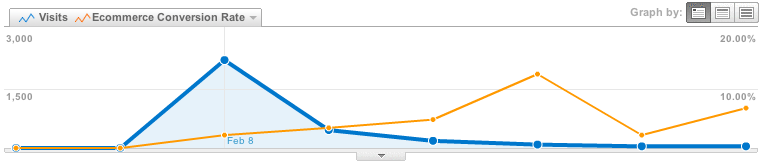
Now this does look odd - isn't it somewhat counter intuitive that the holy grail of all metrics should go up...after visits trail off and then dip and rise again. Gah!
Think about what's happening here: We saw that our AOV was roughlyconsistent...rising slightly even. Well, we can see our visits peak early on and then exhibit the classic long tail pattern. Given that we have seen a close correlation between visits and transactions and our conversion rate is the ratio of transactions to visits, clearly we will see our conversion rate change with the inverse of transactions.
So, in the same way that we would examine the average order value over a multiple day period, we would apply the same analysis methodology to conversion rate.
So, as we were testing one email design against another, we would look at the average order value and conversion rate over a period of say, a week after the email was sent and look for a difference in the metrics. Then of course, seeing mathematical confirmation of statistical significance (say through a simple Student's t-test) is the next step to confirm (or refute) the hypothesis that gave rise to the test in the first place.
Monday, 15 February 2010
RealTime Analytics Part 2
The second part of the Real Time Analytics blog series is found over on 'my other blog':
Analytics in Real Time - What IS art?
Analytics in Real Time - What IS art?
Subscribe to:
Posts (Atom)